Skip to content
Anna Chustecka

Case study 01 · 2025

Marta Waluk’s subscription platform

Turning a stylist’s Instagram audience into a subscription business

Read the case study
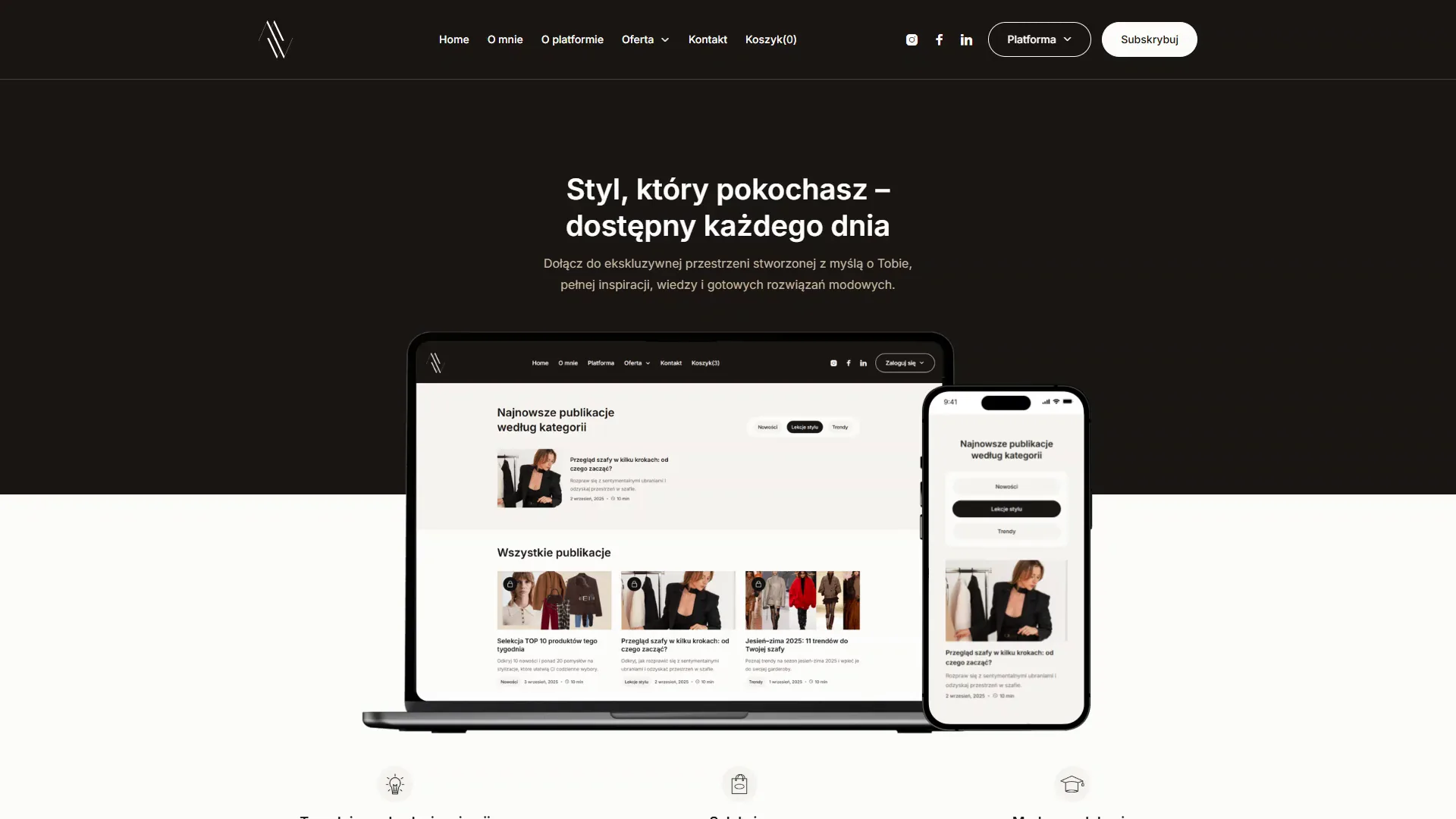
Platform landing page with a laptop and phone preview of the member area
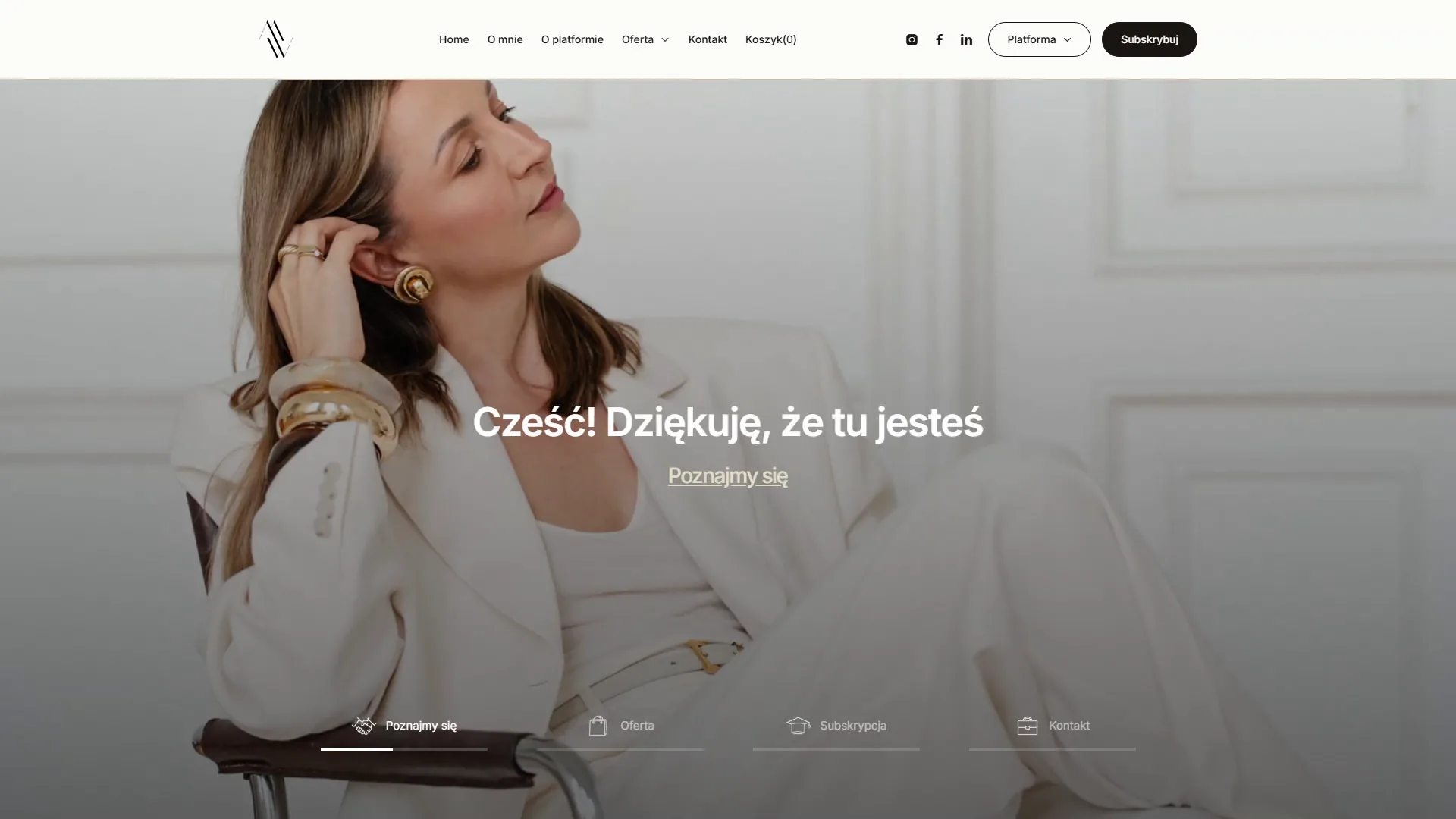
Homepage hero with Marta’s portrait and four entry points
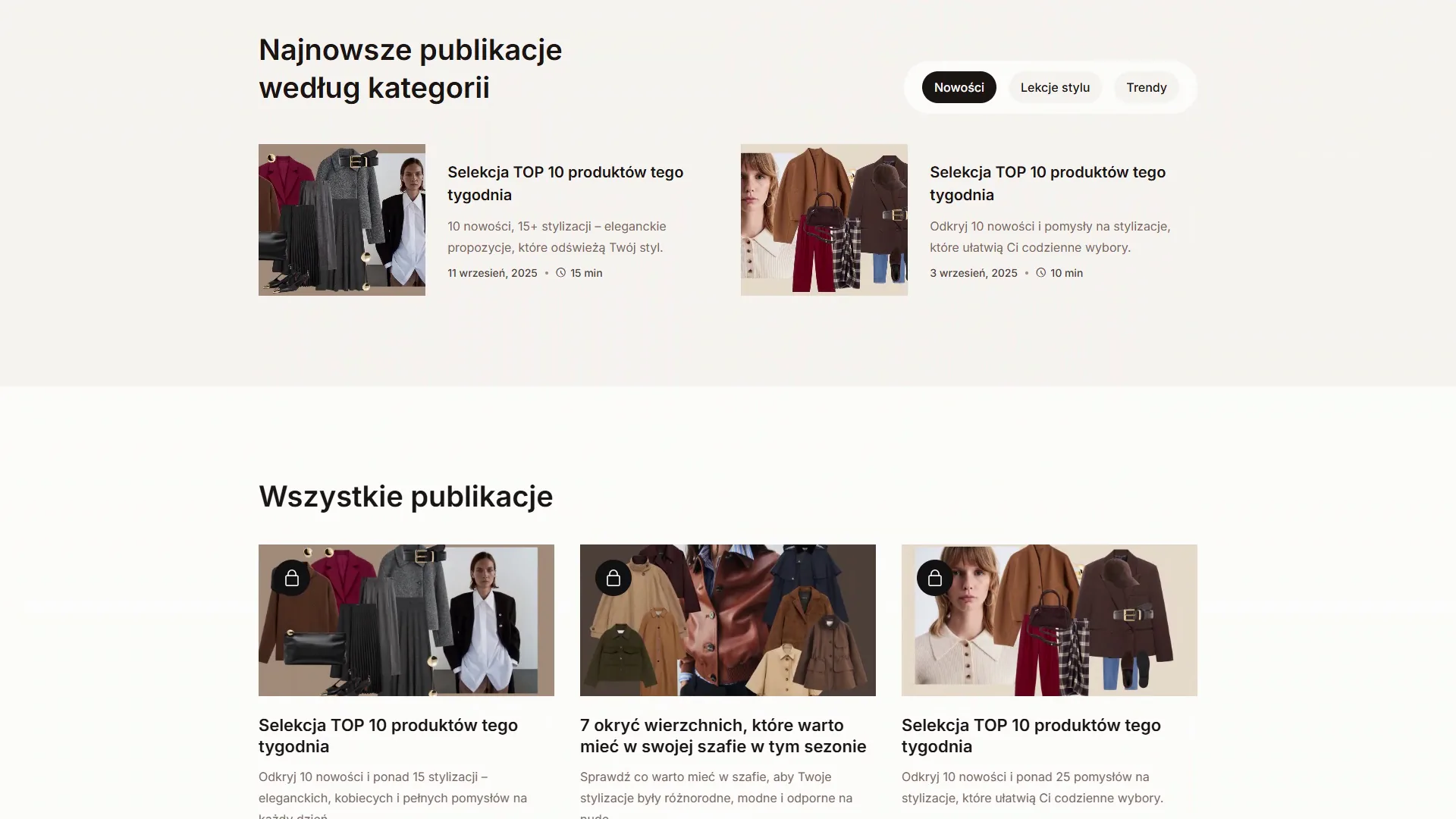
Member area with the latest posts by category: news, style lessons and trends

Platform landing page: the promise, shown on the real product

I designed and built a subscription-based style education platform for stylist Marta Waluk in 3 months. Since its launch in September 2025, 1,477 people have subscribed. The platform currently has 816 paying members, with 56% of subscribers still paying 6 months after joining.

Client
Marta Waluk, a stylist and lecturer with 14+ years of experience and ~60,000 Instagram followers
My role
Sole designer and developer, covering product strategy, pricing, information architecture, UX/UI design, Webflow development, Memberstack and Stripe integrations, branding, copywriting, and SEO
Timeline
3 months to launch in September 2025, with ongoing improvements since launch
Stack
Webflow, Memberstack, Stripe, MailerLite

Metrics as of November 2026

01

Context

Marta’s business relied on premium services. A styling consultation cost PLN 850, and her two-month Style Academy cost PLN 6,999. Around 60,000 people followed her on Instagram and trusted her taste, but her paid services were out of reach for followers with smaller budgets.

Her existing website was little more than a digital business card. It didn’t explain her services, so potential clients couldn’t see what a session involved or what they would get out of it. Every booking had to be arranged through Instagram DMs.

02

The problem

Some followers wanted more than free Instagram posts but couldn’t justify the cost of a 1:1 session. Meanwhile, Marta’s revenue was constrained by her availability: earning more meant taking on more client work.

How might we

… offer followers a more affordable way to learn from Marta, without devaluing her free Instagram content or cannibalizing her premium services?

Success meant growing recurring revenue without a proportional increase in Marta’s workload and retaining paying members over time.

03

Key decisions

01

A paid layer between free Instagram content and 1:1 services

Marta and I started with one question: how could we monetize her audience of 60,000 followers without asking them to spend PLN 850 on a consultation? Before choosing a format, we ran Instagram polls to understand what her followers needed most.

I considered e-books, but they were already common in the niche. A subscription built around Marta’s ongoing curation would offer something different: new guidance and product recommendations each week. Instagram continues to provide free style advice, while members can access more in-depth lessons and curated product selections on the platform. The FAQ reassures followers that her free Instagram content will continue.


Members-only content previews on the homepage
Platform invitation pop-up using the subscriber count as social proof
Decision
A subscription built around Marta’s ongoing curation, positioned between free Instagram content and 1:1 styling.
Trade-off
Ongoing editorial decisions: with every post, Marta needs to decide what stays free and what goes behind the paywall.
02

Content designed to build a weekly habit

Members get two posts a week: a style lesson (for example, which shoes go with which trousers) and a Top 10 product selection with direct shopping links. Including these links addressed a recurring request: followers kept asking Marta where to buy the items she recommended.

The weekly publishing schedule was designed to encourage repeat visits and support subscriber retention. I also set up affiliate links, allowing Marta to earn a commission on qualifying purchases.


Publication dates showing the weekly content schedule
Decision
Two posts a week: a style lesson and a Top 10 product selection with direct shopping links.
Trade-off
The format requires Marta to publish consistently, and linked items can sell out. The FAQ points members to restock alerts.

03

Pricing for a monthly commitment

E-books in the niche typically sold for around PLN 100 as a one-off purchase. We wanted a price members would feel comfortable paying every month, so we benchmarked magazine subscriptions and streaming services. We priced Basic at PLN 29.90 and Premium at PLN 39.90 per month, with a discount of around 10% when billed annually. The Exclusive plan was intended to connect the subscription with Marta’s 1:1 services.

I proposed a monthly billing option for Exclusive to reduce the upfront commitment. Marta preferred to keep it annual-only for her most loyal clients, and we chose that approach based on her knowledge of the audience. Most members choose Basic or Premium, with an approximate 65/35 split. Exclusive has seen limited uptake.


Three membership tiers with a monthly/annual billing toggle
Decision
Basic and Premium with monthly or discounted annual billing, plus an annual-only Exclusive plan linked to Marta’s 1:1 services.
Trade-off
A higher upfront commitment for Exclusive. Its low uptake doesn’t prove that monthly billing would perform better, so the next step is to test a monthly option.

04

Simplifying sign-up within a no-code stack

In the initial implementation, users created an account before selecting a plan. They had to sign up, verify their email, log in, choose a plan and pay before accessing the content.

I chose a no-code stack so Marta could manage day-to-day operations without relying on a developer. I then added Google sign-in to simplify registration. New members can now use their Google account, choose a plan and complete checkout.


Google sign-in on the account creation screen
Decision
A no-code stack Marta can manage independently, with Google sign-in to simplify registration.
Trade-off
Users still need to create an account before they can complete checkout.

04

How I used AI

This was my first subscription platform. I used AI throughout the project, from mapping the subscription model to configuring integrations and generating small custom scripts.

  • Product logic and user flows

    Before designing the interface, I worked through the subscription model with Claude: which content would sit behind the paywall, how plans and billing cycles would work, and which flows members would need, including sign-up, payment, plan changes, payment method updates and cancellation. This helped me map the required screens and identify edge cases, such as failed payments and mid-cycle plan changes, before building in Webflow.

  • Landing page structure

    I used Claude to explore which sections the platform landing page needed, how to order them and different ways to present each one. I then organized the page around visitors’ likely questions and objections.

  • Membership and payment setup

    I used Claude for guidance while configuring Memberstack and Stripe for gated content, recurring billing and member account management. I checked its guidance against the documentation and tested payment scenarios to verify that billing worked as intended.

  • Copy and custom scripts

    I drafted the Polish copy with ChatGPT, whose phrasing I found more natural for this project, then edited it myself. I used Claude to generate small custom scripts for animations and interactions.

For this project, I designed directly in Webflow rather than starting in Figma. This kept design and implementation in one workflow and gave Marta a working site to review as it took shape.

05

The solution

One website brings together Marta’s styling services and subscription platform, with clear paths to booking a session or becoming a member.

Homepage
A hero carousel offers four entry points: an introduction to Marta, her services, the subscription platform and contact information. Further down, blurred previews of the latest members-only posts introduce the paid content, with a single “Get access” CTA.
Service cards and detail pages
Each service card follows a consistent structure: name, a short description, duration, price and one clear action. Each service has a dedicated page, and clients can book a time slot through an online calendar rather than arranging it through Instagram DMs.
Platform landing page
The page presents three core benefits, a content overview, pricing with a monthly/annual billing toggle and a guide to joining. It also includes 20 member testimonials and 15 FAQs covering topics such as sizing, styling during pregnancy, affiliate links and cancellation.
Member area and account management
The member area provides access to content, with monthly live sessions available to Premium members. In their account, members can change plans, update payment details and cancel their subscription without contacting Marta.
Visual identity
An M/W monogram based on Marta’s initials, an earth-tone color palette and understated typography establish a calm, professional visual identity.
Platform landing page
Services on mobile
M/W monogram
One site, two business models
Member area on mobile
Earth-tone identity
Member home (Premium)

06

Results

Metrics as of November 2026

The platform had 816 active paying members, with 1,477 people having subscribed since its September 2025 launch. The reported retention curve showed the steepest decline in the first three months, followed by a more gradual decrease.

  • 816 active paying members
  • 1,477 subscribers since launch
  • 56% subscriber retention at month 6
  • 92.9% payment success rate

More than half of subscribers are still paying after 6 months

Subscriber retention over time

0% 25% 50% 75% 100% Half of subscribers Month 1: 91% still subscribed (average of 12 cohorts) 1 Month 2: 74% still subscribed (average of 11 cohorts) 2 Month 3: 67% still subscribed (average of 10 cohorts) 3 Month 4: 61% still subscribed (average of 9 cohorts) 4 Month 5: 58% still subscribed (average of 8 cohorts) 5 Month 6: 56% still subscribed (average of 7 cohorts) 6 Month 7: 55% still subscribed (average of 6 cohorts) 7 Month 8: 53% still subscribed (average of 5 cohorts) 8 Month 9: 51% still subscribed (average of 4 cohorts) 9 Month 10: 51% still subscribed (average of 3 cohorts) 10 Month 11: 50% still subscribed (average of 2 cohorts) 11 Month 12: 54% still subscribed (average of 1 cohort) 12 91%67%56%54% Months since joining
Stripe subscriber retention report · 12 monthly cohorts, Nov 2025 – Oct 2026 Month 12 rests on one cohort (Nov 2025, 80 subscribers)

Marta brought an established audience and the content. I designed and built the experience of joining, accessing that content and managing a subscription.

  • Close to 500 subscribers in the launch month. The active paying member base remained between 800 and 850 from May to November 2026.

  • Estimated lifetime value. Stripe’s LTV estimate was equivalent to approximately 11–12 months of average revenue per subscriber.

  • Plan mix. Most members chose Basic or Premium, with an approximate 65/35 split.

  • 92.9% payment success rate. Insufficient funds accounted for most failed payments.

What members say

Translated from Polish
  • “I’d rather use your platform than flick through ELLE, which is all ads. I trust you.”

    Platform member

  • “The quality of the materials and the curation is first-class. I’d bought e-books before and was worried about AI rehashes and obvious advice.”

    Platform member

  • “I held off on subscribing, but now I look forward to every new post.”

    Platform member

  • “Buying anything takes me forever. You’re the cure for that.”

    Platform member

07

After launch

At handover, I recorded a training session so Marta could publish content and manage members independently. I continue to work with her on the platform, making improvements based on member feedback.

  1. 01

    Self-service account panel

    Members were contacting Marta for help updating their card or changing plans. I rebuilt the account panel to make both actions easier to find and complete independently.

    Redesigned account panel with subscription and payment settings

  2. 02

    Comments on every post

    Members wanted a way to talk to Marta and one another. I added comments to every post so they could ask follow-up questions and discuss the content. Marta replies in the thread, so other members can benefit from the same answers.

    Member questions and Marta’s replies beneath a post, with member names blurred

03

Simpler sign-up with Google

I added Google sign-in as an alternative to email registration. New members can use their Google account, then choose a plan and complete checkout.

08

What I’d do differently

  1. 01

    Measure the funnel from day one

    We launched without website funnel tracking, so I can’t calculate visitor-to-paid conversion or identify where visitors dropped off. Next time, I’d define the key funnel events and implement tracking before launch.

  2. 02

    Test a monthly Exclusive plan

    Exclusive has seen limited uptake as an annual-only plan. I’d test a monthly billing option to see whether a lower upfront commitment increases uptake, while monitoring its impact on revenue and retention.

  3. 03

    Design for the first 90 days

    The steepest retention decline occurs in the first three months, and new subscriptions now roughly offset churn. I’d use cancellation feedback to understand why members leave, then test whether onboarding improvements help more members stay through the first 90 days.

LAVAHUB handled the entire project from start to finish, including the logo. I really appreciated the commitment, responsiveness and flexibility, as well as the professionalism at every stage. I couldn’t have asked for a better person to work with on my website and subscription platform.

Marta Waluk · Stylist and founder of the platform

Translated from Polish. LAVAHUB was my design studio.

More case studies